Showing posts with label garden. Show all posts

Tea and Willow

Victorian teapot

I am a terrible junk shop explorer.  I simply cannot pass a second hand/ vintage/ charity shop without looking in. So much so I am thinking of opening my own shop with at least a smidgen of vintage paraphernalia.  As a paean to this much enjoyed activity I thought I would start blogging some of my favourite finds. 

Above is my proper old Victorian teapot.  I love the hand painted flowers, the simple swirls that make the leaves and stem. She's a grand old lady.  Although she has quite a lot of crazing, a spiders-web of hairline cracks and that little knob on her lid has obviously been stuck back on at some point in her past, she is still quite capable of brewing a fine cup of tea. 

Royal Doulton Pollards Willow

I bought the Royal Doulton Pollards Willow pattern tea cups, saucers and cake plate at the same time as the teapot.  The pattern is unusual, showing the traditional method of growing pollarded willow for basketry.
  
pollarded willow

I have a bit of a fascination with willow.  I love how they look when grown like this; the knotty trunks contrast with the soft catkins, the straight, spiky, architectural stems that come off the gnarled main trunk can exist in a wide variety of colours; deep red through orange and yellow, to greens and browns that go back to deep red shades all over again.  Below is an image from a fashion magazine (Harpers Bazaar I think) I came across it in a dentists waiting room years ago, loved it so much I took a picture of it.


I attended a talk on basket weaving at one of our gardening club meetings a couple of years ago.  A local basket weaver, Leah, came along to show us the beautiful baskets that she made.  Another thing to go on my ever growing "To Do" list.  

Her talk made me notice on one of my dog walks, that there was obviously another basket weaver living in the village as there were beautifully vivid pollarded willows along the side of a cottage in the fields at the back of us.  It turns out they belonged to Olivia Elton Barratt,the first female Prime Warden of the Worshipful Company of Basketmakers.  Olivia was instrumental in recreating the 16th Century, 14ft high guardians of the City of London, Gog and Magog, in willow for the Lord Mayor's Show in 2007.

gog magog lord mayors show 2007

As it turns out I did my bee keeping course with her daughter and so was able to ask to take cuttings of her willow this spring to use in my own garden.  Look at the gorgeous colours:


I intend to create a fence of pollarded willow to protect the flower garden and veg patch that I am moving to the back of house from the chickens.  I'd also like to grow some along the banks of the Ash along our boundary line.  Yet more to add to the "TO Do" list.

0

Chickens & Quail

Via pinterest saved from Fuji Arts

So, it has taken me more than a month to really get "into" 2016.  Not sure why.  But now it is all go here at Ash Cottage, plans are being hatched.  Our 4 lovely hens; Astrid, Agatha, Anoushka and Ashleigh have proved to be a complete success.  They have so much more character than I ever expected from birds, they have pecked the dogs into some semblance of respectful behaviour and are fun to watch when you're out in the garden.  They have laid all winter and proved their worth in eggs, entertainment and manure.

We let them out to free range most mornings, but they also have a large secure run with their house that they return to without fail at dusk and which they like to hang out in, even when the door is open for them to leave.  So well behaved are the "A-Team", as we like to call our girls, that we are getting more chickens.


I have just reserved 7 chicken hatching eggs for early next month.  I am going to start raising Black Copper, and Silver Blue Marans.  The later are quite a rare variety, in this country anyway.   They are a French breed of chicken, quite large, good for both meat and eggs, which are a dark brown in colour.  And aren't the chicks cute:

The garden is going to be busy this year, because I've just purchased an incubator and my first clutch of Japanese quail hatching eggs too.  Japanese Quail are a relativly large quail and also good for both eggs and meat.  My eggs came in the post from  C& S Quail Company  in Devon.  


It was quite an anxious wait, but they all eventually arrived safely and slightly more than I was expecting.  So, I am conducting a bit of an experiment at the moment.  I have half my eggs in a typical incubator:


 And the others are in a make-shift version of an incubator on the top of the Aga.


I'm not expecting all to hatch, but with any luck in about 12 days time I should have a dozen or so little quail chicks.


Follow on Bloglovin
0

The Last Autumn Weekend


It's been so mild that last weekend we cleared the veg patch and planted more onions and garlic to over winter.  In clearing, I realised that considering we had decided to buy no new veg seeds for the garden, we did quite well this year.

The Herb patch

Green Tomatoes for chutney

Chillies

Tumbling Toms

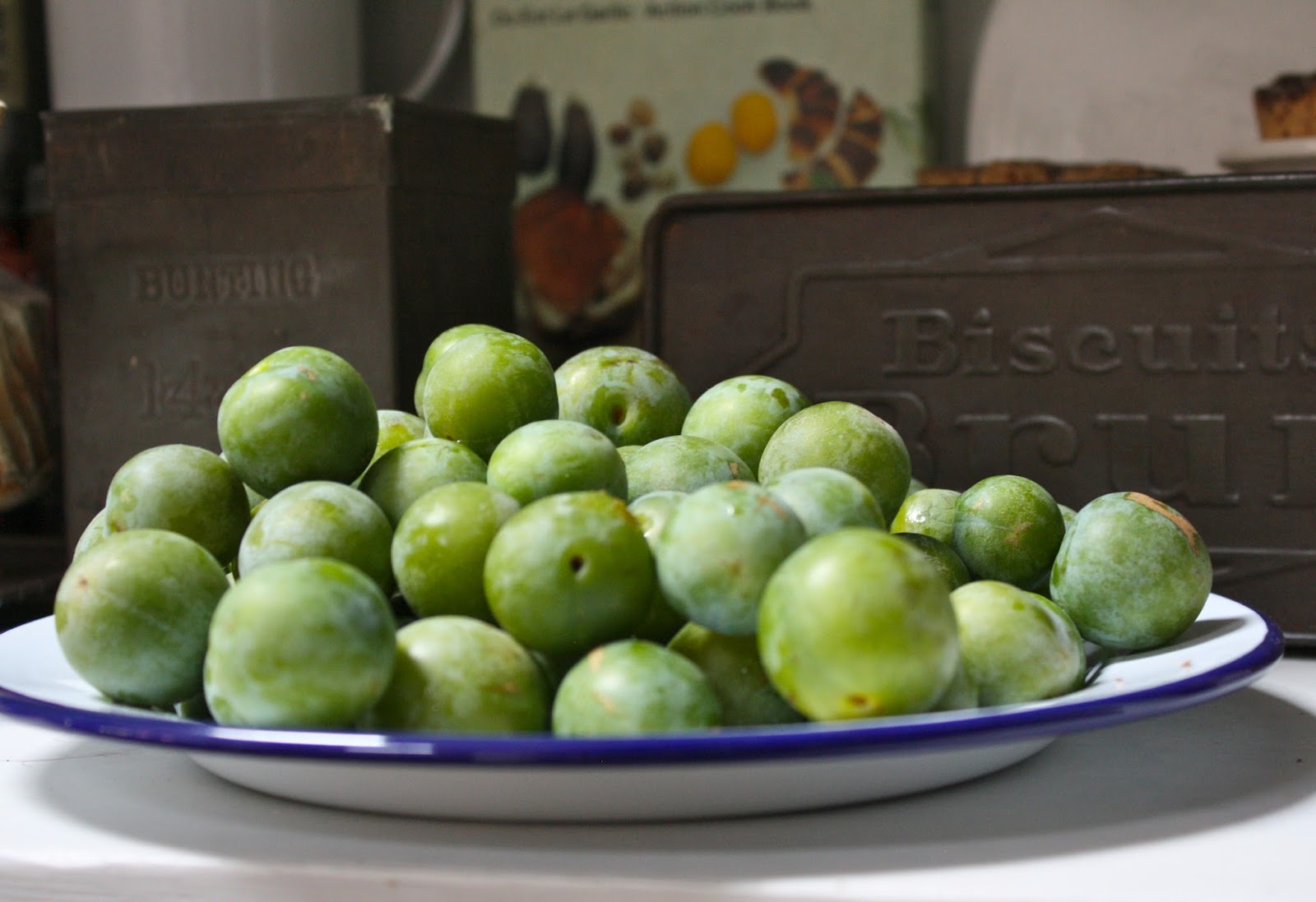
greengages
Greengages - A revelation to me

nigella
Nigella has seeded all over the place from the Roydon Road garden


apple blossom
Apple Trees are not really ready to fruit yet, but give it a year or two

marigolds
Another herb I'm encouraging to self seed all over the garden

quinces
Not grown by me, but I'll be planting a quince tree in the garden next year without fail.


And of course, what else does one do with all this bounty, but eat, eat...
So, I am very excited for next year, when we are officially getting stuck in on the garden.  I've already planted native bluebells and wild garlic along the fence by the river for the bees.   I've not included the bees in the list of this year's bounty - but then we didn't get any honey this year.  The chickens, have been great though, 4 eggs a day and I'd like to increase their number and add ducks and grouse or quail to our menagerie.

Much of the fruit we planted this year was left to get established so, there is some pruning to do before next year when I'm hoping we might get more of a harvest.  The tomatoes did well in the greenhouse, but not so well in the veg plot itself.  So, our old greenhouse from the allotment needs to go up for them next year.  With two greenhouses I'll be able to germinate and raise young plants whilst also allowing tomatoes, chillies and aubergines to thrive under glass.

And we also had a fabulous crop of potatoes this year.  We broke our rule and bought seed potatoes as they were to help us to turn the soil on the new plot.  They were quite neglected, so I am impressed with how well we've done, 4 sack loads.

Mammsaurus HDYGG

Follow on Bloglovin
2

Bees


I have just finished the Beginner's Bee Keeping course with the Bishop Stortford Bee Keepers Association .  It has been lovely to put the kids to bed of an evening and then drive over to Hopleys Garden Centre in Much Hadham to listen, learn and talk about bees with others as enthusiastic (if not more so) as I.  The course was great and I met a lovely group of people, both BSBKA members, committee and fellow "newbies"; thank you all!

In the second week we all made a hive, split into teams we each worked on a different section of the hive.  The team I was in made the brood box and frames.  It was great to realise that with basic carpentry skills I will be able to build and maintain my bees' home.  And doing something with my hands, made the course come alive for me.  I've been babbling about bees to anyone who will listen ever since, reading up on these fascinating creatures, and getting more and more excited that I will soon be a bee keeper.  At the end of the session, whoever emailed first could buy the hive we'd all built.  I was home in a flash and emailed my interest, so here she is in the garden at Ash Cottage.


Thank you John for delivering it - look at that dappled light in the photo.  Apparently bees are into a bit of dappled light.

So, I have the hive and frames, I'm hoping to pick up my first colony of bees on the May Bank Holiday weekend.  I have been browsing the bee keeping suppliers websites for about 4 weeks now in various states of confusion.  I am just about ready to purchase what I think are the absolute essential things I'll need to have for the bees arrival: 
Bee keeper's all in one suit (v. important!), 
smoker, 
J shaped hive tool, 
bee brush, 
1 gallon contact feeder,
...that's what I've got on my order, is there anything else that those of you with more experience than I would say I have to have?

I thought it was the honey and doing my bit for the environment that would be my main interest in bee keeping, but I have become fascinated by the creatures themselves.  Bees are amazing.  Don't get me wrong the honey is still a big attraction.  Little Una Fox gets repeated bouts of tonsillitis.  We use Manuka honey to treat it, and if we catch it early enough it prevents going to the doctors for antibiotics.  I am hoping to switch to raw honey from our own hive for the same result.

And then of course there are all the delicious things you can make with honey.  Sarah, my fellow newbie noticed The Guardian had an article on the Ten Best Honey Recipes  the other weekend, I fancy making the Madeleines.


So soon I will be a bee keeper! < small scream of excitement >


To the land where the honey runs
In rivers each day
And the sweet tastin' good life
Is so easily found
A way over yonder
That's where I'm bound

"A Way Over Yonder" lyrics by Carole King


Follow on Bloglovin
0

A is for Apple


In our garden in North London, when I was a child, we had an apple tree.  Its' apples were tastier than any from a store, climbing it was an adventure and reading a book in it's dappled shade a delight.   I knew when we bought Ash Cottage that we would plant apple trees.  I dream of a wild flower meadow with my children climbing in the branches of the trees to sneak early apples from their boughs.  My chickens perched in the low branches.  Bee Hives below, with the bees foraging among the wild flowers.

We have cut down quite a few trees at Ash Cottage in the last few months and I am a little embarrassed by this.  Not to mention concerned that all the birds that I have seen in the garden will not return.  Along with the bird feeders and bird houses now hanging from the remaining trees, I need to do a bit of tree planting.


However, apple trees are not quite as simple to cultivate as I at first thought.  There are pollination groups and root stock to consider, bare root or pot grown saplings to choose from.  Culinary, dessert, cider or dual purpose varieties, early or late fruiting, tree, bush or pollarding to consider.  Position and situation of the orchard to plan.  I don't remember my parents doing anything but picking apples from the apple tree in our garden.  But then it was an established tree by the time we moved in.

So, I've been reading up, and did some research online, and have chosen a group of three heritage trees;
Grenadier
James Grieves
& Blenheim Orange.

The latter was the first to be chosen;
"Blenheim Orange is a large classic English dual-purpose apple, useful for dessert and culinary purposes. It has the characteristic orange flush which is often associated with English apples".   
This last line in the description called to mind the apple tree in my childhood garden, so it was my first choice.  Blenheim Orange is a triploid, this means it needs two other trees to cross pollinate it.
This then dictates the other trees are from within it's pollination group, group 3, or adjacent groups.  I chose another dual purpose apple - James Grieves,
"...raised in Scotland at the end of the 19th century, the height of the Victorian period of apple development in the UK. It is a very juicy apple, producing plenty of sharp-tasting apple juice."
James Grieve is an excellent pollinator for many other apple varieties and is a variety that matures mid-season, while Blenheim Orange is a late variety.  

My final choice was Grenadier, an early season cooking apple, that is apparently "fool-proof" to grow.  I ordered bare root trees.  These are young trees that are dug up whilst the tree is dormant for winter. They can usually be ordered between November and March and need to be in the ground by the end of this month, before the tree comes out of it's dormant period.


They were delivered last Monday by courier, in a box, quite large, bare, twigs with a bit of netting on the bottom.  As they are dormant, they look, well, to be honest, quite dead.  It feels like we have just spent a lot of time planting dead bits of twig in the ground and I keep going out there and gazing at them in the hope of seeing something that looks a bit more alive.  I made the classic error, that I was warned against in my reading, of not preparing the holes before the trees arrived and as my last post details they were delayed going into the ground by a long deeply sunk metal post, or 3.

I ordered the trees on M26 rootstock.  This is a semi-dwarf variety.  Rootstock, and I think I may be becoming an apple tree nerd here, I found fascinating.  Apples trees are made up of 2 parts, the largest part being the scion, which is the fruiting tree of the variety you have chosen, and it's rootstock, which in apple trees is usually another apple tree.  The scion is grafted onto the rootstock primarily to control the size of fruit trees, but also allow trees to grow in local environmental conditions and may provide some disease resistance.   However it is not a straight forward as root-stock = tree size, local conditions, pruning and species of tree all play a part.


I was going for a tree, but not too massive so M26 rootstock is bigger than M9 (which is used in commercial orchards) but smaller than M111.  As apple trees are probably the first trees humans ever intentionally grew for fruit, and have been cultivated for thousands of years in Asia and Europe, we've spent a lot of time messing with them, grafting them onto this, that and the other.

So I know that my M26 rootstock is derived from the M9 (or MIX) rootstock produced in 1917 by the East Malling Research Station in Kent (still up and running; http://www.emr.ac.uk/).  M9 is derived from the Paradise rootstock "Jaune de Metz".  Paradise was the most widely used rootstock in the 19th Century with a wide variety of vigours and no standardisation, until the East Malling Research Station began classifying rootstock and developing new ones for specific purposes in 1912.

I'm sorry, I told you I've become a rootstock nerd.  Anyway I found the whole thing fascinating and it has made me want to plant a mixed fruit orchard.  We have about 6 fruit trees already in the garden; 3 greengage, and 3 damson or plum trees, we think.  There is also a little line of sloe bushes at the end of the garden.  I would like a Quince tree.  Raspberries, gooseberries, black currants and rhubarb are going over in the veggie patch.  And Mum has given me a fig tree, but I think I am going to return that to a plant pot over by the house as it is more sheltered.


READING:

River Cottage Handbook No.9 - Fruit by Mark Diacono
Fork to Fork - Monty & Sarah Don

LINKS:
When I was looking to purchase trees I found both the following nurseries' really helpful and informative both online and in person on the phone.  I only bought from one, but it simply came down to what stock they had available as I was trying to purchase the bare root trees late.

http://www.blackmoor.co.uk/

http://www.orangepippintrees.co.uk/

Joining in with Annie at Mammasaurus for "How Does Your Garden Grow" again this week.

How Does Your Garden Grow
7

Reading List Two


This is a great book for anyone new to keeping chickens.  It orders the information well and is concise enough not to overwhelm, I like the way Mark Diacono writes.  I also love the pictures I will admit and this series of handbooks is becoming something I lust after.  Our chicks; Agatha, Astrid, Ashleigh and Anoushka were born last Wednesday and will be with us on Thursday in time for Easter.  Little Louis Fox has been counting down the days.

Mr Maggs is not my favourite person at the moment.  It seems that, when it comes to the Aga, I always do the opposite to what I am supposed to do, according to him.  -SIGH!-  However it seems there is a lot I need to know so I will swallow my pride and get on and read it.

Allotment Month by Month by Allan Buckingham
This book was our absolute bible 5 years ago when Mr Fox and I got our allotment.  It is a clear, practical and concise reference guide to what needs to be done in the garden and when.  Ours is covered in mud, ripped and water damaged, but I will still refer to it to get my brain in gear as I begin the work on our veggie patch.

About 10 years ago Mr Fox and I went to Cornwall on holiday and visited the Eden Project, while we were there we went to see the Lost Gardens of Heligan.  I came away feeling they were more amazing than the Eden Project itself.  I bought this book in the book shop, there were about 10 other books I would have loved too.  The Heligan Vegetable Bible is a book I love to flick through and make lists of the heritage breeds of fruits and veggies it mentions.  Heligan is an inspirational garden, and this book captures the depth and breadth of the amazing Victorian Country House garden.

Fork to Fork by Monty and Sarah Don
Mr Fox bought this for me one Christmas around a decade ago.  I love it, I've read it from cover to cover.  It is a beautiful book and I find it an inspiration.

And in case you are interested here is my Reading List One post.


Follow on Bloglovin
0

The Garden at Ash Cottage - An Introduction

ladybird ladybug

The mild weather that we had before Christmas, along with keeping the ladybirds out and active, allowed us to get a really good start on the garden.  One of the main attractions of our new home is the garden at Ash Cottage.  It is about an acre in size, with several out-buildings and a 60ft chicken run, loads of BIG trees and incredibly over-grown.  The first thing we had to do when we got in was cut everything back, so that we could see what we have.

trees

What we have are a lot of very large trees that make the house and garden dark and prevent other plants from growing, but with views and hints of how beautiful it could all look once we get to work on it.

Ash Cottage - line of trees

garden ash cottage

garden ash cottage

So, we went for it with the trees, all the leylandii except 1 were cut down; that's 8 trees (1 felled by the other Mrs Fox & I); plus an 11ft hedge of 7 more leylandii cut down by Neil with his trusty chainsaw; plus the 3 or 4 trees cut down by the electricity board (at our behest) to make safe the power-line that runs across the garden.

tree felling garden ash cottage

Most of the trees had to be climbed to be felled, there was not enough space to allow any of them to go down without them falling on a house, out-building, chicken run, caravan or other trees.  The tree surgeons didn't think any of the trees had been touched for a minimum of 20 years.  We still have tonnes of dead wood that needs to be cut out of the remaining trees to make them healthier and safer.

tree felling garden ash cottage

After all the cutting down we've had huge bonfires to get rid of all of the wood and leaves, that are of little use in wood burners due to all of the oils in their timber.  We are still working our way through this wood, huge long piles of tree limbs have been; trampolines, pirate ships, castles and forests for the children to play in and on for the last 3 months.  They will be sad to see it finally all gone, and we have re-learnt that primeval enjoyment of just gazing at a big bonfire, poking it and stoking it and listening to it crackle and flame.

garden ash cottage
Add caption

Despite all our felling we still have plenty of mature trees in the garden, including a large beech and sycamore tree that are over 100 years each, 4 more young sycamore, 5 silver birch, a willow, field maple, a cherry tree and several damson and greengage trees, 3 more substantial evergreens still standing, numerous hawthorn and elder, and I'm not even mentioning the various large shrubs.

Along with clearing the trees here has also been a vast amount of rubbish; old swings, barbed wire, garden machinery, chairs, wood, oil drums, cabling, concrete, glass, rubble, an old MG engine buried in the compost.  The compost heap itself was about the size of a small urban garden and needed to be moved as it was rotting the neighbours fence it had been leaning against.

garden ash cottage

All this space in the garden allows us to say "Goodbye" to our allotment (sad day though it was) and incorporate the veg patch into our garden.   Here's the final destination of that compost heap; but it's back breaking work.

veggie garden ash cottage

And it is the veggie garden that has absorbed most of my attention this week.  At one side of the garden is a hexagonal greenhouse that I have been renovating the last few days, clearing of ivy, cleaning, re-hanging shelves and re-making benches.  Sadly neglected like the rest of the house and garden, it is being returned to it's intended use and now is home to two trays of tomato seeds.

hexagon greenhouse ash cottage

And to make up for my decimation of bird habitat, we have put out feeders and bought nest boxes to go up in the remaining trees.  Yesterday I ordered 3 apple trees and we've a walnut tree waiting to go into the ground too.

Simple Wanderlust


Follow on Bloglovin
10

A Momentus Day in the Garden

seed trays in the greenhouse
Seed Trays - Tomato Curo Di Bue, Super Marmande & Tumbling Toms
Yesterday I planted something in the garden (in seed trays in the greenhouse) rather than chopping something down, digging something up, moving something to another place or throwing something away.

  Follow on Bloglovin
0
Back to Top